
Septic tanks – Wastewater treatment
Septic tanks – Wastewater treatment
Sewage turned into clean conventional water
Why should wastewater be treated?
Each person generates 100 liters of wastewater every day. 50-60% of this volume ends up in the sewers.
Immediately after use, it becomes ‘spent’ and is discharged from the living space. If the dwelling is connected to a sewerage system, the water goes to a communal/municipal treatment plant.
If there is no sewerage system, then the water has to be purified – the process by which it is made conventionally clean – and then returned to the natural water cycle (discharged).
The lack of such equipment often extends over a fairly wide area in the neighborhood. Beyond legal requirements, water treatment is a matter of responsibility, health and comfort.
In septic tanks, domestic sewage is partially clarified and then discharged into soakaways or drains. Septic tanks strongly release swamp gas, ammonia (NH4), carbon dioxide (CO2), hydrogen sulphide (H2S) and very little methane (CH4), so effective aeration is necessary.
Water also needs to be purified to keep us out of trouble and secure resources for future generations!
Location: Satu Mare, county Satu Mare
Executionyear: 2020
Projectname:Sewage water transformed into conventionally clean water
Products/Systems used: AquaCLEAN- Wastewater treatment system
AquaCLEAN- Wastewater treatment system
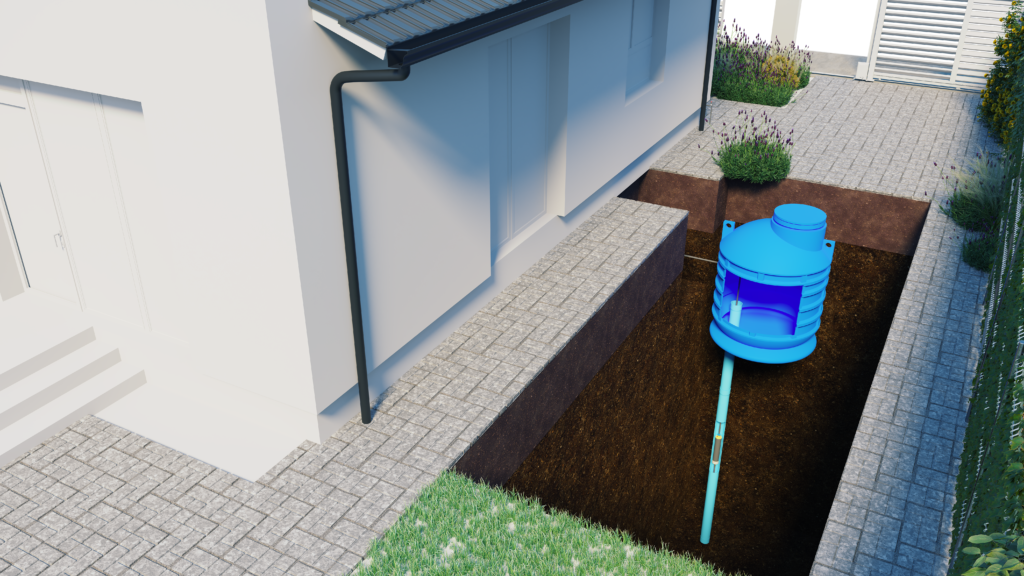
1. Dig the installation pit big enough so that you have a 30-40 cm space around the basin, the space needed for the compactor;
2. Cut the soil at the base of the pit and pour a reinforced concrete invert of about 10÷30 cm that will support the weight of the basin;
3. Lower the tank into the pit, position it and make sure it is in a stable and firm position;
4. Connect it to the sewage and water drainage;
5. Mount the ventilation, (!) The ventilation can be extended with a PP tube with socket, DN 110. It is recommended that the level of the ventilation end piece is above 1-1.5 m above ground level;
6. Fit the cover position adjustment fittings (if required);
7. Fill the space between the basin and the pit with alternating layers of soil or sand, about 30 cm thick, and tamp;
8. The pit must be filled with clean water before commissioning and after each emptying;
9. If installed as a drainable sump, the drain connection shall be plugged and shall NOT be filled with water when commissioned;
10. In order to avoid unpleasant odors in your home, we recommend that you install a chimney with a siphon and a directional flap between the house and the pit.